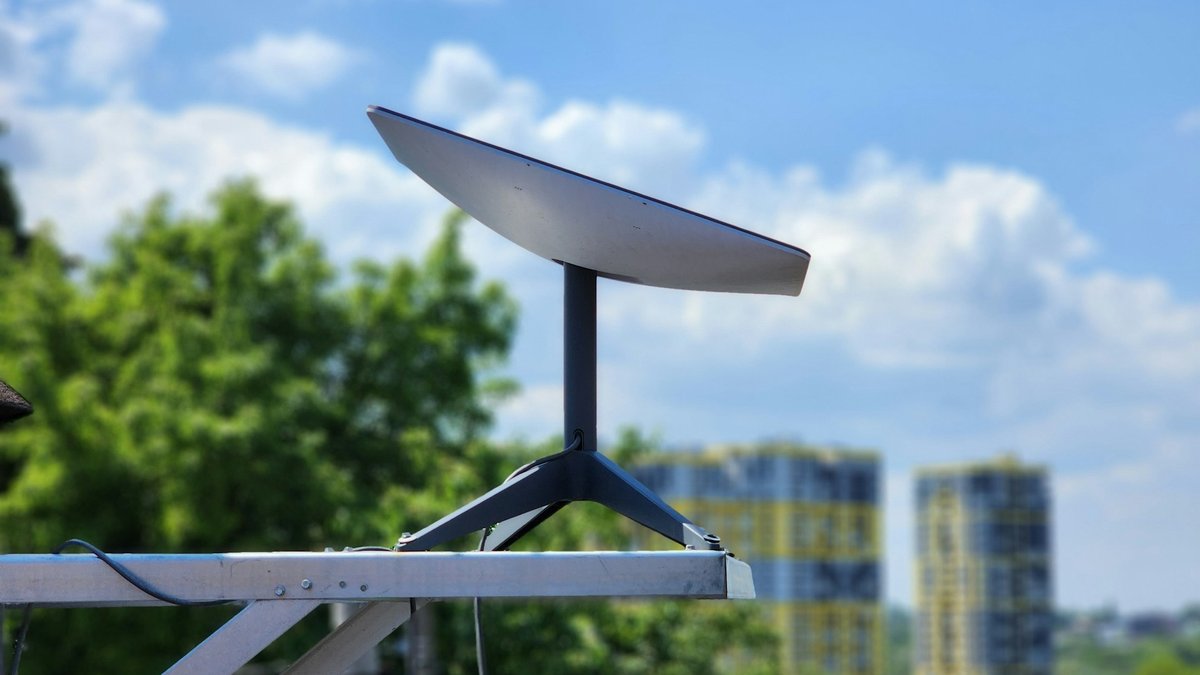
Russian forces spent much of the Ukraine war relying on a technology they were not supposed to have. Smuggled Starlink terminals, obtained through third-party countries and registered under false identities, became central to Russian battlefield communications: drone coordination, troop movements, command and control. When SpaceX disabled them on February 4, 2026, Ukraine recaptured 400 square kilometers of territory in the weeks that followed. A Russian soldier's description of what his unit was left with captured the collapse plainly: radios, cables, and pigeons.
The Starlink story is not simply a technology story. It is a story about how a private satellite network became the most consequential single asset in a modern war, and how Donald Trump used control over that asset, alongside oil sanctions and mineral rights, as three interlocking levers of pressure on both sides simultaneously.
How Russia Got Dependent on Starlink
Russia's use of Starlink was an open secret long before it became a crisis. Russian forces began acquiring terminals through bordering countries as early as 2022. By 2025, thousands of smuggled terminals were operating across the front line, providing the kind of low-latency, high-bandwidth satellite connectivity that Russia's own military communication systems could not match.
The dependency was rational in the short term and catastrophic in the long term. Starlink worked better than anything Russia had. It allowed drone operators to maintain reliable connections over contested terrain. It gave commanders real-time situational awareness. Russian units that had access to it performed measurably better than those that didn't. The problem was structural: every terminal was registered with a private American company, operating under American legal jurisdiction, with a kill switch that could be activated remotely.
SpaceX had already demonstrated willingness to use that switch selectively. Musk had restricted Starlink coverage near Crimea in 2022 to prevent a Ukrainian submarine drone attack on the Russian fleet, a unilateral decision by a private citizen that directly affected active military operations. The possibility that the same switch could be used against Russian terminals was always present. Russian military planners either did not take it seriously or had no viable alternative.
When the switch was flipped in early 2026, in coordination between SpaceX and Ukrainian intelligence, the effect was immediate. A declassified US Defense Intelligence Agency assessment confirmed that disabling the terminals disrupted Russian command-and-control systems significantly. Ukraine's first territorial gains since 2023 followed. Russia's planned expansion of naval drone operations in the Black Sea, in development throughout 2025, was also directly derailed. It is worth noting that as of March 2026, Russian troops still maintained an overall advantage over Ukrainian forces in most combat functions. The Starlink shutdown hurt Russia badly but did not flip the war.
The Elon Problem
Musk's position in this war has no historical parallel. He is simultaneously a defense contractor, a political adviser, a diplomatic back-channel, and the owner of infrastructure that two armies depend on. His proximity to Trump meant that Starlink access and American foreign policy became impossible to fully separate.
When Russia attempted to obtain terminals through bordering countries, Musk blocked all unregistered devices, enforcing a form of commercial sanctions that the US government had not formally imposed. When Ukrainian forces pushed aggressively beyond agreed operational boundaries and Russia threatened nuclear escalation, Starlink access to those operations was restricted, a signal from Washington delivered through a private network rather than through diplomatic channels.
None of this was governed by law, treaty, or democratic accountability. The decisions were made by one person, on a timeline and rationale that were not publicly disclosed. That a private company's commercial infrastructure became a decisive military asset in a major war, and that its owner became a de facto participant in foreign policy, is one of the more significant governance failures this conflict has exposed.
Three Levers, Two Countries
Trump's approach to Ukraine and Russia in 2025 and 2026 was transactional in a way that was more explicit than most American foreign policy. He was not managing a rules-based international order. He was negotiating deals, and he had three things to offer or withhold.
The first was Starlink access, the battlefield communications backbone Ukraine depended on. The threat of restricting it was a credible one, and Ukraine knew it.
The second was the minerals deal. Ukraine holds significant reserves of rare earth metals and lithium. Trump made clear early in his second term that American support was not unconditional. After a confrontational meeting at the White House in February 2025, he pressed Zelenskyy to sign a mineral rights agreement, explicitly linking continued support to resource concessions. The deal was signed in April 2025. Russia responded with predictable sarcasm, with Dmitry Medvedev noting that Ukraine would have to use its national wealth to pay for military supplies from the country supposedly helping it.
The third was oil sanctions. When the American-Israeli campaign against Iran sent global oil prices surging in early 2026, effectively closing the Strait of Hormuz and cutting off roughly 20 percent of global oil supply, Trump faced a domestic political problem. Gas prices in the United States had risen sharply, and the war he had started was the primary cause. In March 2026, he temporarily lifted sanctions on Russian oil in transit, providing direct financial relief to the Russian war economy. European allies objected. Ukraine called it a betrayal. The Kremlin welcomed it and pushed for more.
All three levers were operating simultaneously. Ukraine was being squeezed for mineral concessions, threatened with Starlink restrictions, and watching sanctions on its enemy ease. Russia was receiving sanctions relief while having its smuggled terminals disabled while facing the threat of new oil tariffs if peace negotiations stalled. Both sides were being pressured. Neither side trusted the outcome.
Russia's Answer: 16 Satellites
Russia's response to its Starlink dependency problem has been to try to build its own constellation. On March 23, 2026, a Soyuz rocket launched 16 satellites for a project called Rassvet, meaning Dawn, developed by a private aerospace company called Bureau 1440 and backed by $5.26 billion in combined government and private funding.
The scale of the gap is instructive. Starlink operates over 10,000 satellites in low Earth orbit. Russia launched 16. Bureau 1440 plans to reach 156 satellites by end of 2026, 292 by 2027, and 318 by 2028. Even at full buildout, Russia's constellation would be roughly 3 percent of Starlink's current size. Military analysts note that Rassvet, if it reaches operational scale, would give Russian forces a communications backbone that cannot be switched off by a foreign company. That is a genuine strategic improvement. But the timeline is long, delays are already evident, and Western sanctions restrict access to the components that satellite manufacturing depends on.
The project is also a symptom of a broader problem. Russia overinvested in conventional military hardware: artillery, armor, missiles. It underinvested in the communications and technology infrastructure that modern warfare actually runs on. Ukrainian drone operators with reliable Starlink connections consistently outperformed Russian units with superior firepower but degraded communications. The lesson has been visible for years. Russia is now trying to address it, four years into a war that has already demonstrated how expensive that gap is.
What This War Is Teaching
The Ukraine conflict has forced a reassessment of several assumptions about modern warfare. One of the clearest is that connectivity is now as decisive as firepower. A unit that cannot communicate, cannot coordinate drone operations, cannot receive real-time targeting data is at a severe disadvantage regardless of how much artillery it has.
A second lesson is about the vulnerability of dependency on commercially owned infrastructure. Russia's Starlink problem is an extreme version of a risk that exists for any military relying on civilian technology without having direct control over it. The kill switch problem is not unique to Starlink. It is a structural feature of any military that borrows civilian infrastructure rather than building its own.
A third lesson is about the nature of American support in the Trump era. The minerals deal, the Starlink leverage, the sanctions relief, taken together, describe a United States that is still involved in the Ukraine conflict but has explicitly monetized that involvement. Support comes with a price, denominated in mineral rights, behavioral compliance, and geopolitical concessions. Whether that represents a sustainable basis for an alliance is a question Ukraine is in no position to answer independently.
The Bottom Line
Starlink did not win the Ukraine war for Ukraine. But it changed the war's character fundamentally, and Russia's failure to account for its own dependency on smuggled Western satellite technology became one of the conflict's more consequential strategic errors.
Trump recognized the leverage that control over that technology represented and used it alongside sanctions and mineral rights in a negotiating strategy that treated both Ukraine and Russia as parties to be pressured rather than allies to be supported or adversaries to be confronted.
Russia responded by launching 16 satellites and calling it a milestone. The gap between 16 and 10,000 is not closed by ambition. It is closed by years of manufacturing, launches, and investment, time that Russia's military does not have while the war continues.
In the meantime, the radios and cables will have to do.